Across the UK, a young person’s postcode still determines far too much about their future. Despite years of discussion about levelling up, geography remains one of the strongest predictors of opportunity. Young people growing up in rural, coastal or post‑industrial communities consistently face limited access to skills, training and career pathways, particularly into technical and STEM fields.
At the same time, our industry is facing a generational challenge. Construction and engineering remain ageing workforces, and too few young people are choosing STEM careers. We talk often about the “talent shortage,” yet we continue to treat it as an isolated recruitment issue rather than a systemic one. The reality is simple: the talent we need exists, but it is not evenly distributed, and neither are the opportunities to access it.
If we want to solve this problem, we must stop relying on small, isolated outreach events and start working together to create large‑scale, long‑term programmes that reach the communities that need them most.
This is why we are so proud of the Reds10 Academy programme we have developed in close collaboration with Driffield School and Sixth Form and The Talent Foundry, a UK charity dedicated to improving social mobility for young people. Together, we are building a T Level construction pipeline designed specifically for the needs of the local community and supporting the introduction of the Construction T Level into the school’s curriculum as an alternative to A Levels for young people in Driffield and East Riding.
Our aim is to raise awareness of technical education routes, create clear progression pathways and remove geographical and practical barriers, ensuring young people can build meaningful careers locally.
Building a Local Pipeline in East Yorkshire
This partnership model is especially crucial in post‑industrial regions where opportunities are harder to come by. In East Yorkshire, for example, the Social Mobility Commission places Hull among the lowest local authorities nationally for “promising prospects.” The result is that young people from lower‑income families remain significantly more likely to become NEET, a gap that has barely changed in a decade.
For many students in rural or post‑industrial areas, travelling to larger cities like Hull or York is not always possible. Long journeys increase costs, limit access and contribute to dropout rates. By creating a pipeline that begins in local schools and extends through T Levels into apprenticeships and employment at Reds10, we are helping ensure that geography does not limit ambition.
Raising Awareness of Technical Pathways
T Levels have the potential to reshape technical education in the UK. They offer young people high‑quality pathways into skilled careers and give employers direct access to emerging talent. With the financial premium of a university degree narrowing, raising awareness of these pathways is more important than ever, yet many students and families still lack clear information.
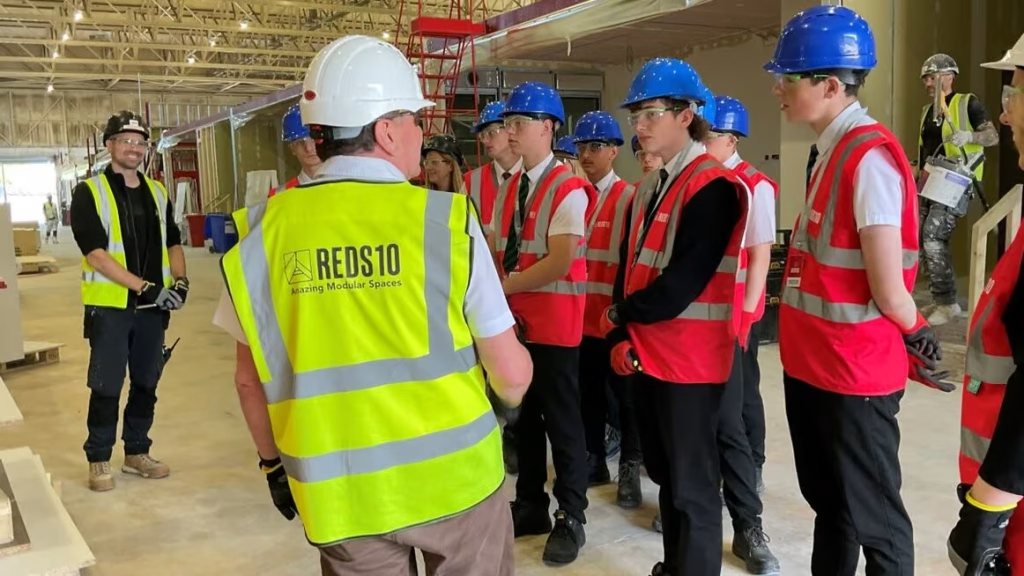
Through school engagement, workshops and insight sessions, we give students the chance to experience what a technical career in modern construction looks like. This early exposure builds confidence, supports informed decision‑making and positions T Levels as a high‑quality, respected route into skilled work rather than a “second choice.”
The Impact on Young People
For young people, especially those from underserved communities, the benefits of T Levels are transformative.
Our T Level programme in London demonstrates the power of this model. Students are introduced to a wide range of construction careers, engineering, design, surveying, project management and more. As our Chairman, Paul Ruddick, explains:
“T Levels open up a breadth of pathways. Whether a young person wants to become a joiner, an engineer, a designer or a project manager, these placements give them the chance to discover what suits them and to see a future for themselves in our industry.”
We Need Broader, Bolder Action
The challenge our industry faces is that we rely too heavily on small, isolated initiatives that reach only a handful of students at a time. Assemblies, short workshops and career fairs have value, but they will not fix the long‑term talent challenge we all agree exists.
If we want real change, we need wider‑scale, structured, multi‑year programmes built through collaboration, not competition.
Our partnership with The Talent Foundry in Driffield shows what is possible when employers commit to long‑term, community‑focused investment. But one programme in one region is not enough.
As Paul Ruddick puts it:
“This is a long‑term commitment. By combining the strengths of educators and employers, we can create practical routes into meaningful employment and deliver change where it’s needed most.”
Talent is everywhere, opportunity is not, and it’s time we changed that.