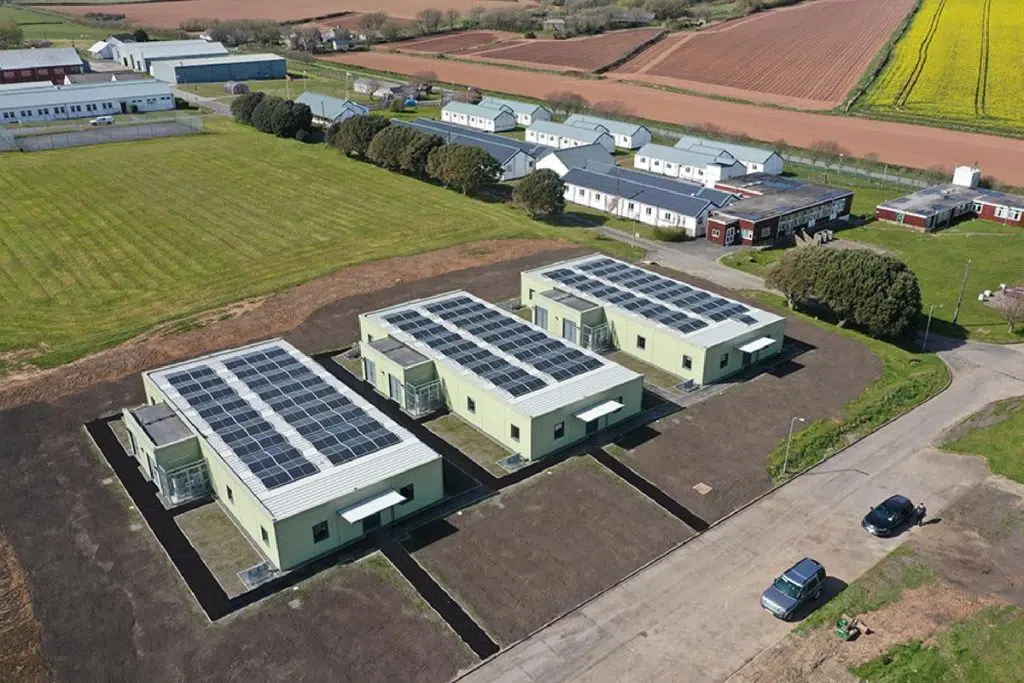
- Reds10 is delivering modern, sustainable Single Living Accommodation (SLA) that supports RAF Marham’s role as the UK’s Main Operating Base for the F 35B Lightning Force.
- Industrialised modular construction has accelerated delivery, improved safety, and minimised disruption across both project phases.
- The project meets strict BPS, Net Zero and embodied carbon targets, ensuring long term efficiency and resilience.
Reds10 is delivering four new Single Living Accommodation (SLA) blocks for RAF Marham, providing 376 modern, en suite bed spaces for Junior Ranks. RAF Marham is the UK’s strategic Main Operating Base for the F 35B Lightning Force, and the project forms a crucial part of the Air Infrastructure MPP, replacing outdated Grade 3 & 4 SLA with sustainable, future proof homes that support operational readiness.
Procured through the NHS SBS Modular Buildings Framework, the scheme is being delivered in two phases. Two buildings are nearing completion, while the remaining two are being delivered in 2026 under an improved, industrialised factory process to accelerate programme time and maximise safety.

The Challenge
RAF Marham required high quality accommodation that meets Building Performance Standards (BPS) and aligns with MOD sustainability targets, while maintaining operational continuity on a busy, strategically important base.
Existing SLA buildings were outdated, offering poor thermal performance, lack of privacy, inefficient layouts, and failing to meet modern comfort expectations. Site conditions created logistical constraints, with storage situated outside the construction boundary and limited access for deliveries, turning, and material handling.
The project also had to comply with Net Zero Carbon in operation, meet embodied carbon thresholds, integrate with existing services across a complex live site, and avoid disrupting the activities of lodger units and ongoing construction programmes across the base.
The Solution
Reds10 is delivering four identical SLA blocks, each containing 94 private rooms with en-suite bathrooms, communal kitchens, laundry rooms, social spaces, cycle stands, garages, and lift access.
Using 87% offsite manufacture, the modules are produced in Reds10’s East Yorkshire factory, enabling consistent quality, reduced on site activity, and faster assembly. The transition from Factory 1’s pre industrialised process to its improved industrialised method means the Phase 2 buildings will be delivered even more efficiently. The new system achieved a 50% reduction in steel frame erection time, while completely eliminating all working at height risks for factory teams.
To support the MOD’s sustainability and resilience objectives, the design incorporates:
- Air source heat pumps
- Photovoltaic (PV) panels
- SMART Building Management System (BMS) integration
- Energy saving room automation and leak detection
- Low carbon materials aligned to ≤600 kgCO₂e/m² embodied carbon targets
Buildings 1, 2, and 4 have already achieved results 6.7% below the embodied carbon target, with Building 3 on track. Factory forklifts have been converted to fully electric, saving 76 tonnes of CO₂ across the project.


The Result
The nearly completed buildings already demonstrate a step change in the lived experience of RAF Marham personnel. Bright, spacious en-suite rooms and well planned communal spaces provide enhanced privacy, comfort, and wellbeing — directly supporting morale and operational performance.
SMART in room controls allow occupants to personalise comfort while optimising energy use through vacancy and window open automation. The buildings are on track for BREEAM and DREAM Excellent, and operational systems contribute to an overall A+ energy rating.
Modular delivery significantly reduced noise, traffic and disruption on the active base, helping ensure the RAF can maintain full operational capability throughout construction.
Phase 2, scheduled for 2026, will leverage the improved industrialised factory process to deliver the remaining two buildings faster, more safely, and with further carbon reductions.